












Python for Structural Engineers

Learn to automate workflows with Python. Become a better structural engineer.

Discover how to build your own engineering tools, automate repetitive work, and free up more time for real engineering. Flexible learning for busy engineers, with skills you can apply straight away.

  • No programming experience required
  • Practical lessons for real-world projects
  • Integrates with any engineering software


649€

  • Lifetime access
  • 30-day satisfaction guarantee

Learn with 600+ professionals from companies like

No affiliation or endorsement implied.

“This should be a fundamental course for structural engineers.”

Szabolcs Polyak

Structural Engineer

Do you wish you could focus on engineering instead of tedious tasks?

You are often slowed down by repetitive tasks.

You process FEA data manually, and design iterations are slow.

You struggle to find the time to learn new skills.

THE SOLUTION

Automate you workflows with a practical Python course for Structural Engineers

You work eight hours a day. Imagine if you could make your computer work for you. With a little coding knowledge you can work faster, smarter and build more ambitious things. We built this course with eLearning experts to deliver focused lessons that you can apply right away.

Automate slow engineering workflows with Python

Learn to use python libraries to process data effectively.

Fully self-paced learning – use AI to go faster.

We signed up Engineers in the last cohort! [...] they have already build a suite of little tools to help solve real world problems!

Matt Wash

CEO Bimbeats

CURRICULUM

Learn precisely what you need for daily engineering work. Clear, focused, and practical lessons.

─ 0 Python Fundamentals

Python Fundamentals

From your first line of code to simple tools for everyday engineering calculations. No programming experience required.

─ 01 Plotting

Make your analysis results easy to communicate with matplotlib.

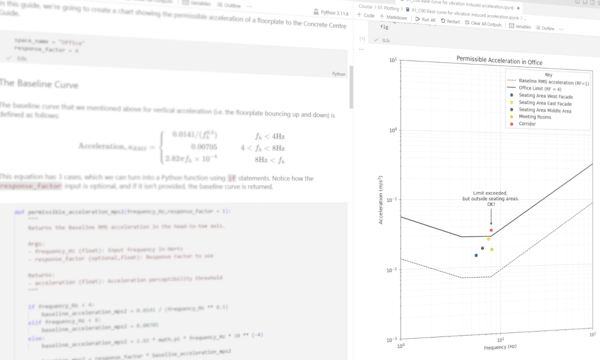
Master Matplotlib to create clear, beautiful, professional plots. The many examples include pile capacity, sensitivity analysis, and material quantity/cost plots

─ 02 EXCEL unleashed

Automate slow spreadsheet workflows with pandas.

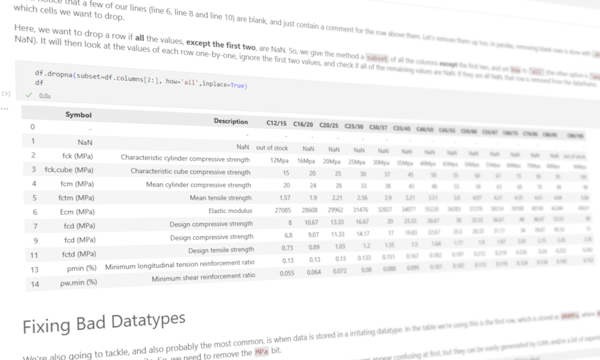
Use Pandas to process, analyze, and organize engineering data from Excel. Examples include steel section catalogues and concrete test data. You’ll build tools that save hours of repetitive work.

─ 03 Finite Element Models with Text Automation

Make repetitive model edits and file handling simple with os.

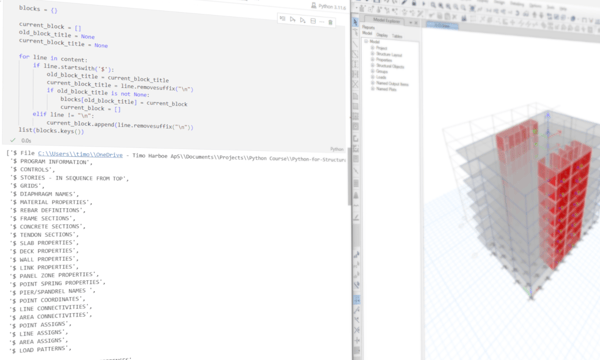
Use Python’s os module to modify finite element models through text file editing, and to manage and organize files and folders on your computer with automation.

─ 04 Finite Elements Analysis Results Post-Processing

Say goodbye to hours of repetitive and error-prone work.

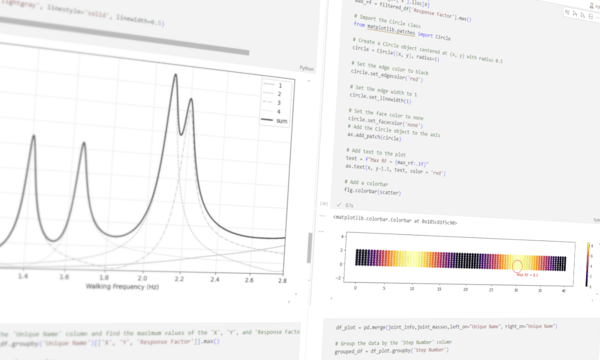
Use Pandas to build templates that process FEA results effectively — from comparing FE models to summarizing member forces. What once took hours or complex VBA now takes minutes with a few clear lines of Python.”

This course stands out among industry-focused learning resources. The instructor’s hands-on expertise makes it worth every euro.

Daniel Manzano

Senior Implementation Consultant Autodesk

HOW YOU’LL LEARN

Every lesson gives you automation skills you can apply right away.

Meet the Team

Timo Harboe Zollner

Structural Engineer

I’m a structural engineer with experience across Europe, Asia, North America and Africa. Projects I’ve been part of range from landmark structures like City Wave in Milan, to art installations like the Orb at Burning Man, to bridge design automation in South America, to standard residential buildings.

I’ve worked in Rambøll High Rise and at Bjarke Ingels Group, and now I run my own automation consultancy.

I was always frustrated with the Excel calculation templates I had access to. They felt like black boxes, difficult to QA, and whenever I wanted to set up more advanced workflows I had to look towards VBA or Queries, which I just often found too complicated for everyday engineering tasks.

I’d known Python for years, but it wasn’t until I came across a course in Data Science in AEC that I discovered how extremely useful it could be for engineering. My first script automated the generation of wind load plots—showing how much wind the cores resisted compared to the rest of the building, across all load combinations. Up until then I’d spend hours cleaning data and creating plots one by one in Excel. Suddenly, it was all done with a few click. A complete game changer.

Later, I built a simple tool to visualize pile reactions. It generated clear plots of forces for every load combination in the model, so after each update I could instantly drop the latest results into our design document. Before long, a colleague with no Python experience picked up the script and absolutely loved it.

This was the moment I knew I had to create this course. I want to make an impact in the lives of engineers. I want to improve their chances of having the career and the job they dream about. And I want more engineers to actually have fun in their work.

So that’s why this course exists. I’m sure you’ll be as excited about this as I am.

Enjoy the learning journey!

Best regards,
Timo Harboe Zollner

Sam Dixon

Structural Engineer

I’ve put together many of the lessons, exercises, and case studies for this course. I’m passionate about structural design and have worked on high-rise towers, lab spaces, and cultural venues.

I learnt Python during my degree at the University of Cambridge, and I have found Python to be an extremely powerful tool in nearly all aspects of structural engineering.

Now, I want to be part of helping our industry to use Python more effectively.

Amalie Langkjær

E-Learning Specialist, MB & Partners

I’m skilled at breaking down complex ideas into engaging and enjoyable e-learning experiences. Using my analytical skills, I make tough concepts easy and fun for everyone. My approach is shaped by my Master’s degree in Education, ensuring effective and fun learning. I have supported Timo and Sam through various workshops to ensure the course meets e-learning best practices.

What our students say

Steve Dizon
Structural Engineer
Highly recommended to all practicing Structural Engineer

An excellent course for structural engineers to apply programming skills in practice, especially using Python.

Rubén Establés Antón
FEA Analyst @ Tecnicas Reunidas
Really useful and enjoyable

I really enjoy learning a lot about Python and its application in Structural Analysis.
It is a very good structured course with plenty of explanations and examples to learn about this topic.
It is demonstrated the work that is behind it.
Thank you very much.
I recommended it 100%

Krisjanis Kucins
Structural engineer
Excellent course, tailored for structural engineers

Well structured and taught in an engaging way. The best part was the well-tailored exercises, which clearly guide you on how to solve problems efficiently with code. This course helps you learn not only how to code, but also how to use coding to simplify everyday engineering tasks.

Kewal Raval
Engineer – Bridges @ WSP
Content and flow of the course

Quality and flow of the contents (the way module has been arranged) is nicely clubbed within the course.

Flavio Natale
Associate @ Ayesa
Great Course for Beginners

I took the course over the span of a couple of months. Even though it only barely scratches the surface on programming, it’s a great beginning step that helps understand many many programming concepts and strategies.
At the end of the course, with some practice, you may be able to generate some interesting scripts.

Agustín Colacce
Structural Engineer @ BBG Estructures
Instant application in daily work

This is a python course but entirely dedicated to structural engineering. That means it gives instant tools for daily work, as explained by the teachers, they are not lying! Although you won’t feel totally confident in the use of python after the course, in my experience, I had already managed to make some cool tools for my office, and have the necessary tools to continue learning and improving.

Salsala Absal
Structural Engineer
Best course for Python

This is the best course for learning Python for a beginner like me. Timo explains everything in a simple and easy-to-understand way. His teaching style is clear, friendly, and well-paced. The lessons are short but full of useful information. I like how he uses real examples to explain the concepts. It helps me understand how Python works in real life. The course structure is very organized.

Matteo Turrini
PhD student
A different perspective, essential to make a difference, even among engineers

Python is a tool that will become increasingly essential, because automating processes allows you to immediately focus on the design choices that matter, optimizing them.
If you want to make your profession more conscious, but also more cheerful, choose this course!

Arthur Olet
Regional Engineer
This course will change your practice

The popularization of AI and the potential replacement of all professionals with it was a deep-seated fear I had before pursuing this course. Who would like to disappear into complete irrelevancy in the near future?
This course has allayed my fears allowing me to see AI as an assistant, improve my presentation, thinking and turnaround time without having to invest too much time in learning python.

FAQ

Structural Engineers. The course is 100% centered around the daily tasks of a structural engineer. If you work with buildings, bridges, industrial structures or any other kind of load bearing structure this is for you. 

Basic structural engineering knowledge is required, but no programming experience is needed. The first module covers Python fundamentals.

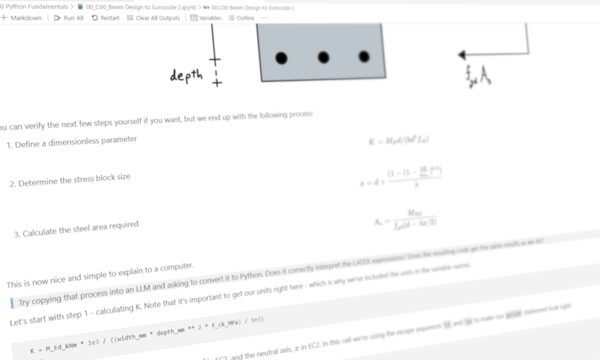
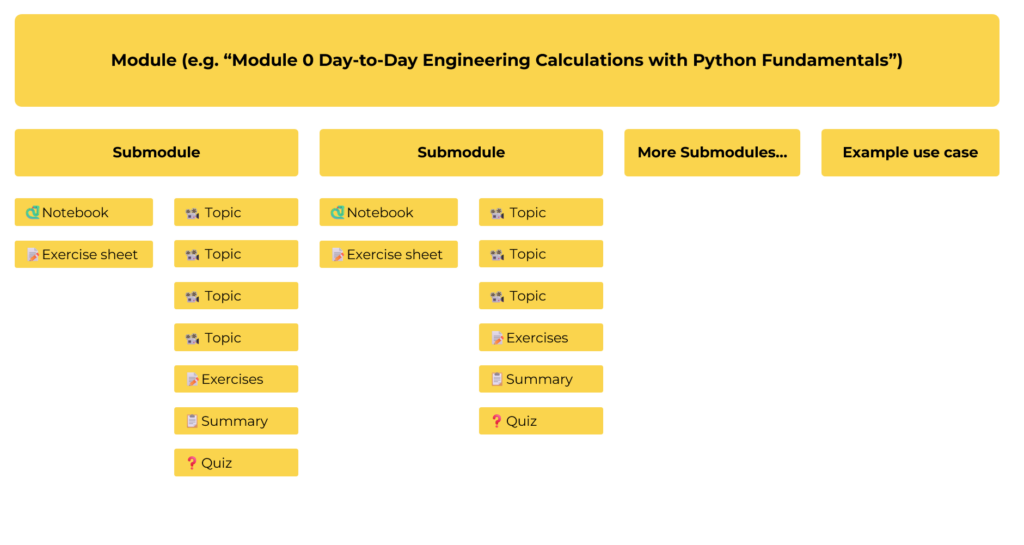
The course has 5 modules, each divided into submodules with interactive notebooks, exercise sheets, and video explanations. Complete exercises, review summaries, and pass a quiz to proceed. Some modules end with larger example use cases.
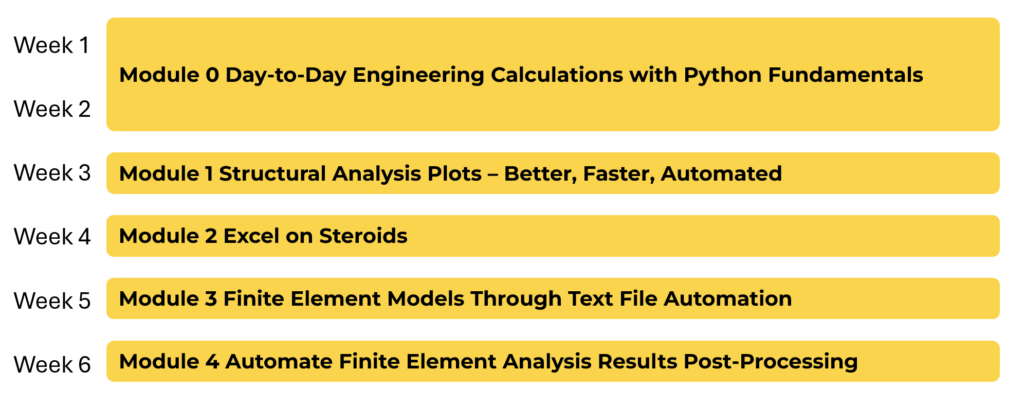
The course is designed for 6 weeks, with 4-6 hours per week. Move steadily through the first module to build a strong Python foundation; then, complete the remaining four modules at your own pace.
When you purchase access to the course, you receive:

  • Interactive Notebooks: All course content, including comprehensive explanations and code, is provided in written format as interactive notebooks. 
  • Exercise Sheets & Quizzes: Practice your skills with exercise sheets and test your knowledge with quizzes.
  • Video Lessons: Over 100 detailed, short, and professionally edited videos explaining the learning material.
  • Lifetime Updates: If new material is added to the course, you’ll be notified and granted access.
  • Community Forum: Join a forum where my partner and I are active, and engage in discussions with fellow students.

This is an on-demand, recorded course. Access it online, complete at your own pace, and enjoy lifetime access.

No, the course is designed to be independent of any specific software package.

No installation is required; the entire course can be completed online using Google Colab (free). You may choose to install Python locally as this will allow you to do everything that Python can do (also free).

Yes, enjoy a 30-day satisfaction guarantee with a full refund if you’re not satisfied. Terms and conditions apply.

We won’t be using Grasshopper in this course, but everything you learn can be applied directly in it. If you’re a Grasshopper user, learning Python is one of the best skills you can pick up!
Be a
better Structural Engineer

Shopping Cart

This will close in 0 seconds

Scroll to Top